Two subtotals
Items 1–5 describe obsessions; items 6–10 describe compulsions. Each subtotal ranges from 0 to 20.
100% FreeNo Email RequiredInstant Browser Scoring

Professional OCD Assessment
Use a free educational self-screen based on the Y-BOCS structure. Get a browser-calculated severity score to discuss with a qualified clinician. This is not a diagnosis.
Y-BOCS
Based on the Y-BOCS structure
Assessment Standard
Every OCD test on this site is built on the Yale-Brown Obsessive Compulsive Scale, published in 1989 and still the most widely used measure of OCD symptom severity in both research and clinical practice.

Assessment features
Explore the Y-BOCS structure, calculate a score locally, and read the original research. This website’s adaptation has not been independently clinically validated.
Ten core severity items cover time, interference, distress, resistance and control.
Understanding your score
The score adds your ten core responses. It does not use AI to analyze your answers, diagnose OCD or recommend treatment.
Items 1–5 describe obsessions; items 6–10 describe compulsions. Each subtotal ranges from 0 to 20.
A qualified clinician can interpret the score alongside symptoms, history and daily functioning.
The five color bands provide a quick reference for the 0–40 total. They are not diagnostic thresholds.
An online self-screen cannot establish or exclude OCD, assess every possible condition or determine treatment.
Why Choose Our OCD Test
Experience the difference with our comprehensive evaluation system
The original Y-BOCS has published research; that research does not independently validate this online adaptation.
See the sum of your ten core responses as soon as all are answered.
Answers and scores stay in browser memory. The assessment does not upload or save them.
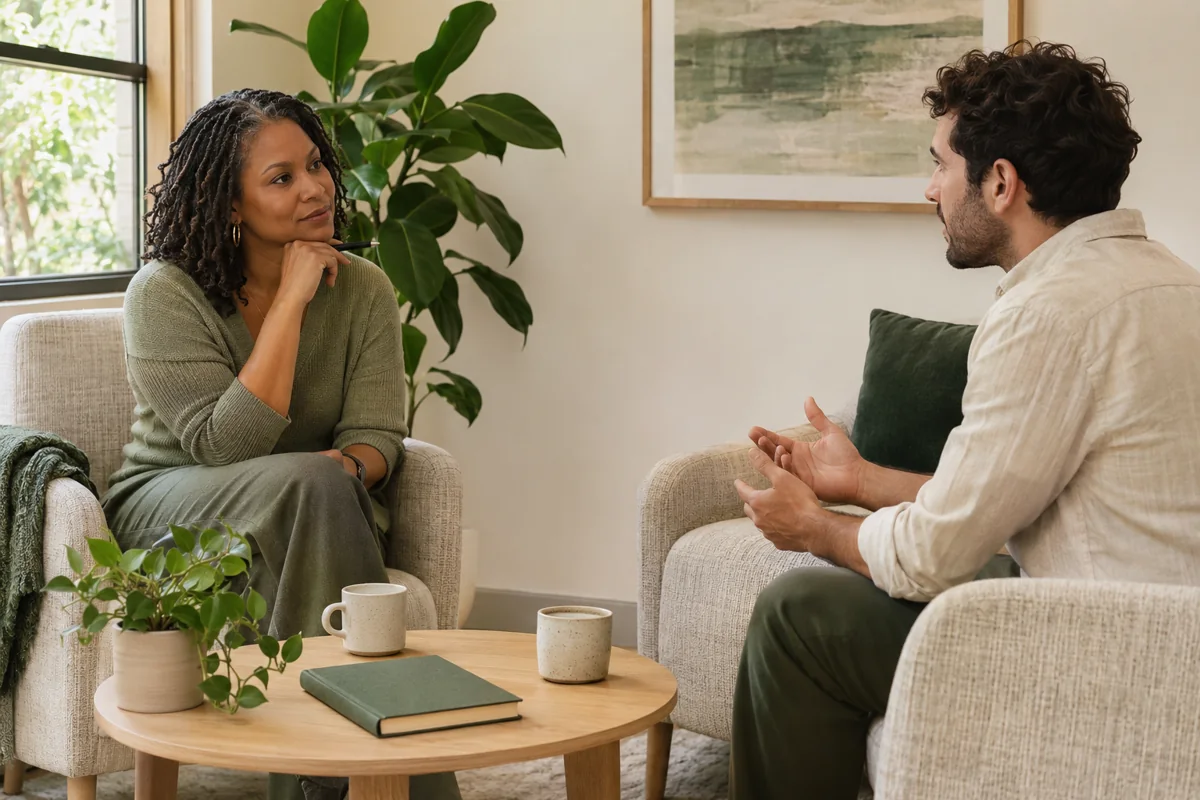
OCD Test Guide
An OCD test is a structured screening questionnaire that measures how much obsessive thoughts and compulsive behaviors affect your daily life. Here is what our OCD test looks at, how to read the score it produces, and where the limits of any online OCD test lie.
Each of the ten core items is scored from 0 to 4, so a completed OCD test produces a total between 0 and 40. A higher number means symptoms are consuming more time and causing more disruption — it is not a measure of how unwell a person is as a whole. These are the conventional Y-BOCS severity bands your OCD test report is measured against.
| 0–7 | Subclinical — Symptoms are present but rarely disruptive. |
|---|---|
| 8–15 | Mild — Noticeable symptoms that interfere with parts of the day. |
| 16–23 | Moderate — Symptoms take substantial time and cause clear distress. |
| 24–31 | Severe — Symptoms dominate much of the day and limit functioning. |
| 32–40 | Extreme — Symptoms are incapacitating and warrant prompt clinical care. |
Obsessive-compulsive disorder has two halves, and a useful OCD test measures both. Obsessions are unwanted, intrusive thoughts, images, or urges that keep returning and provoke anxiety — fears of contamination, of harming someone by accident, of having left the stove on. Compulsions are the repetitive behaviors or mental rituals people use to neutralize that anxiety: washing, checking, counting, ordering, or silently repeating a phrase until it feels right.
Our OCD test follows the structure of the Yale-Brown Obsessive Compulsive Scale, the instrument clinicians have relied on since 1989. Rather than simply asking whether symptoms are present, the OCD test rates five separate dimensions for obsessions and then again for compulsions: how much time they consume, how far they interfere with work and relationships, how much distress they cause, how hard you try to resist them, and how much control you feel you have over them.
Consider taking an OCD test if intrusive thoughts occupy more than an hour of your day, if rituals have started to shape your routine, or if people close to you have noticed the checking and the requests for reassurance. Distress that keeps returning to the same theme week after week is worth examining.
Many people wait years before mentioning these symptoms to anyone, often because the thoughts themselves feel shameful or bizarre. A private OCD test is a low-pressure way to put language around what you are experiencing and to decide whether it is worth raising with a clinician.
No online OCD test can diagnose you. A diagnosis requires a licensed professional who can take a full history and rule out conditions that resemble OCD, including generalized anxiety, body dysmorphic disorder, tic disorders, and autism-related routines. Treat the result of this OCD test as a structured starting point rather than a verdict.
The encouraging part is that OCD responds well to treatment. Exposure and response prevention, cognitive behavioral therapy, and SSRI medication all have strong evidence behind them, and most people who complete a course of ERP see meaningful improvement in how much space their symptoms take up.
Methodology & Sources
You should be able to see the reasoning behind any OCD test you take. This section sets out how the assessment is scored, what kind of instrument it is, and the published sources it rests on.
The assessment opens with a symptom checklist covering the common obsession and compulsion categories — contamination, harm, symmetry, checking, washing, counting and the rest — so the OCD test can establish which themes apply to you before it measures how intense they are.
Ten core items then rate severity: five for obsessions and five for compulsions, each scored from 0 to 4 across time occupied, interference, distress, resistance and control. Adding them together produces the 0 to 40 total, and your OCD test report maps that number onto the published severity bands.
One caveat worth stating plainly: the original Y-BOCS was designed to be administered by a trained clinician as an interview. This OCD test is self-report, which makes it fast and private but also means no interviewer is there to calibrate your answers. Self-report versions correlate well with clinician ratings, though they can diverge at the extremes.
Assessment Methods
We use various validated methods to ensure accurate OCD test results
Gold standard assessment tool for OCD severity measurement
Comprehensive evaluation of compulsive behaviors and rituals
Daily monitoring of OCD symptoms and triggers
Evaluation of obsessive thoughts and cognitive patterns
Assessment of how OCD affects daily life and functioning
Tracking progress and response to interventions
FAQ
Explore your symptoms with an educational self-screen. Your score is a starting point for discussion, not a diagnosis.
These sources explain the original instruments and clinical context. Citing them does not imply that their authors reviewed, endorsed or validated this website.
Basis of the Y-BOCS structure: a clinician-rated symptom severity scale, not a stand-alone diagnostic test.
Related research: OCI-R is a separate self-report instrument. This website’s Y-BOCS score is not an OCI-R score.
Diagnostic context for qualified clinicians. This website does not administer DSM-5-TR diagnostic criteria or establish a diagnosis.
Newsletter
Subscribe to our newsletter for the latest news and updates